
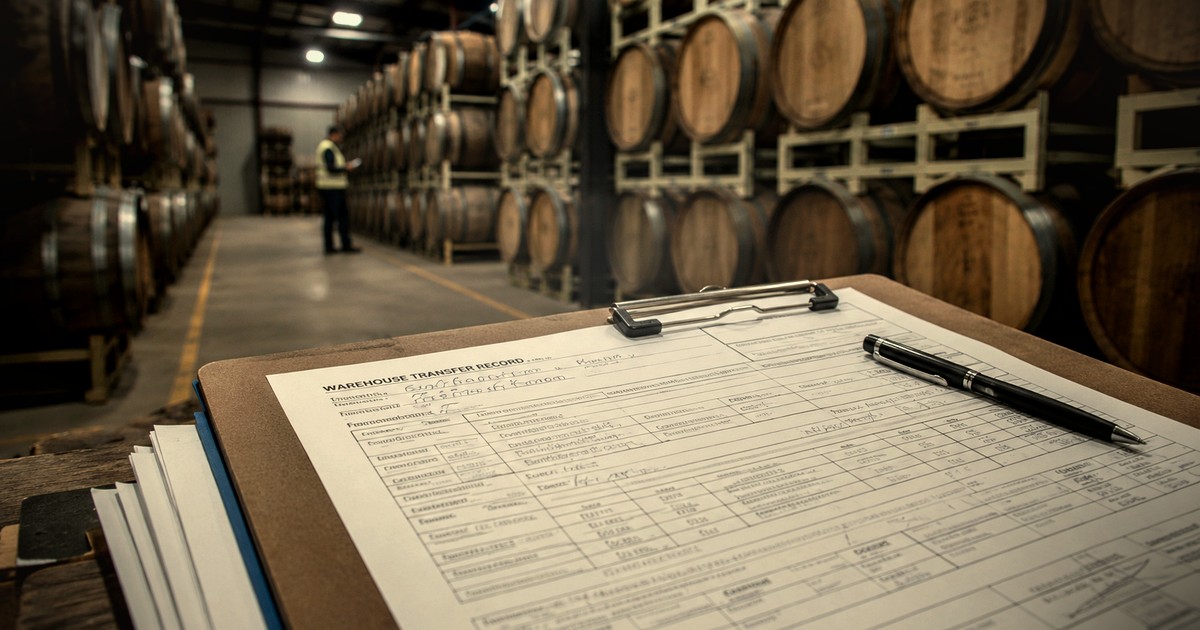
Most of what gets bought and sold in the cask-aged spirits market never touches a public listing. It moves through relationships: a distillery sells to a trade buyer, a trade buyer sells to a broker, a broker holds the cask and sells to the next buyer in the chain. By the time a private buyer or collector owns the cask, the warehouse price may have passed through two or three hands. They rarely know how many, and the original price is not published anywhere.
This opacity is not incidental. It is structural. It is what the traditional broker model depends on.
How Casks Move Through the Market
The mechanics are straightforward, even if the pricing is not. A distillery fills a cask and sells it at an ex-warehouse price to a trade buyer. That price reflects the distillery's cost of production, expected maturation yield, and margin. It is never published.
The trade buyer (an independent bottler, a broker, or an intermediary) takes ownership. They may hold the cask for years, resell it to another intermediary, or offer it directly to private buyers at a marked-up price. In many cases, a second or third broker sits between the original purchase and the final sale.
A 2025 Spirits Business investigation described this market as a "pyramid with different levels of cask," noting that brokers "work discretely" and that "you wouldn't find them on social media." The insight is not that the brokers are bad actors. It is that the pyramid structure is by design invisible to the buyer at the bottom.
At the point of sale, the end buyer faces a price that reflects the distillery's original ask, plus margin accumulated at each layer it has passed through. The buyer has no benchmark to compare. As the same investigation observed: "All the cask sellers quote similar prices."
What Each Layer Costs
The cost of the broker layer is not always a single, visible fee. It is embedded in two distinct places.
- Commission at sale. For the exit transaction, specialist brokers typically charge 10-15% commission on the achieved price, per current market practice (Mark Littler Ltd, 2025). This is the visible cost, and it comes off the seller's proceeds.
- Markup on entry. When a broker or platform buys a cask wholesale and sells it to a private buyer, the margin between wholesale acquisition cost and the listed price is not disclosed. Depending on how many layers the cask has moved through, this can be the larger number. Some platforms in the market have been documented operating with margins embedded well above the commission figure, with the difference invisible to the buyer at point of purchase.
For buyers without access to warehouse pricing data, both costs are effectively hidden. There is no published index for ex-warehouse cask prices. There is no public record of what the seller paid. The buyer's only reference point is what competing sellers are also asking, and in a market with limited participants and informal pricing norms, those prices converge rather than compete.
The Supplier-Direct Model
Cask Capital operates differently. Warehouses and distillery partners work with Cask Capital to list casks at supplier-agreed pricing. Cask Capital does not purchase inventory and mark it up. The listed price reflects the commercial terms agreed with the supplier for that cask, including what is bundled into the share price (such as storage and insurance for the listed period).
This is not a minor operational detail. It is a structural choice that changes the economics for every party.
- For the supplier, it means exposure to a buyer pool without routing through a broker relationship. The platform provides infrastructure for discovery, verification, and transaction settlement. The supplier sets the commercial terms; Cask Capital lists and settles against those terms.
- For the buyer, it means the listed price reflects what was agreed with the supplier for that cask, not a chain of undisclosed intermediary markups. Listing metadata (distillery, fill date, warehouse, cask type, valuation curve) is published on the product page. Token ownership and transfers after mint are verifiable on Hedera via HashScan. That is a different transparency profile than paper cask ownership passed through private broker chains.
- For the platform, it means the business model rests on transaction economics, not on the spread between a wholesale purchase price and a retail ask. Cask Capital has no stock to move. The alignment with buyers is structural, not incidental.
What Asset-Light Unlocks
The implications of not carrying inventory extend beyond pricing transparency.
Inventory-heavy models carry a structural constraint: the platform's capital is tied up in the casks it holds. This limits the speed of category expansion, because each new category requires balance sheet capacity. It creates a potential conflict of interest between the platform's inventory position and the buyer's interest in fair pricing. And it makes certain product features difficult to develop.
A secondary trading market is easier to build when the platform does not need to manage the price of its own inventory against the prices of trades it facilitates. Collateralized lending against fractional cask positions (on Cask Capital's roadmap, targeted for Q1 2028) is structurally cleaner when the platform is not simultaneously a creditor with an inventory book. A quarterly buyback program at independently appraised values (targeted for Q3 2027) is structurally cleaner when the platform is not calibrating exits against an inventory book it needs to protect.
None of this means every product feature is live today. The secondary marketplace is live: holders can list shares for resale from their dashboard, and the on-chain mechanics are operational. Depth is still early-stage, as you would expect in a young cask resale market, not a deep-liquidity exchange. Lending and the quarterly buyback program are roadmap items, clearly dated. But the structural point holds: the asset-light model creates the conditions for features that inventory-heavy models can only offer with significant conflict-of-interest mitigation baked in.
There is also a supply-side consideration. Warehouses and distillery partners who list through Cask Capital retain control of their pricing terms. They are not selling wholesale to a platform that will then compete with them on the secondary market. That relationship is different, and in a market where long-term supplier relationships determine what actually comes to market, the difference matters.
What It Does Not Change
It is worth being direct about the limits of the model.
An asset-light platform does not automatically mean lower prices. Suppliers set their own asks, and a supplier with a desirable cask will price accordingly. Transparency about the number of intermediary layers does not compress the warehouse ask. A sought-after Speyside hogshead commands a high price whether it is listed through a broker or directly through a platform.
Nor does removing broker margin change the fundamental characteristics of cask ownership: spirit quality, maturation outcome, angel's share loss, and the liquidity profile of holding a cask over a long horizon. Those belong to the cask itself and are present regardless of the distribution model.
What the asset-light model changes is the clarity with which buyers can evaluate what they are paying for. When the listed price reflects supplier-agreed terms, and ownership is recorded on-chain after mint, the due diligence task is substantially simpler than when the same information is distributed across bilateral agreements and undisclosed broker relationships.
In a market defined by opacity, that clarity is not nothing.
Start exploring
The cask-aged spirits market has traded on opacity for decades. That opacity is the broker's structural advantage, and it is not going away for the market as a whole. But it is not an immutable feature of every platform that operates within it.
A supplier-direct model with published listing metadata and on-chain ownership after mint gives buyers more to verify before they commit. It does not guarantee the outcome of any individual cask purchase, and it does not change the underlying characteristics of the spirit in the barrel. What it changes is how much the buyer can see before they commit. For buyers and collectors used to being the last to know the price chain, that is a meaningful shift.
Explore current listings on app.caskcapital.io. For a walkthrough of how ownership, custody, and settlement work, see how it works.